The shared structure
All three Parsi calendars share the same structure:
- 12 months (Mah) of 30 days (Roj) each, named Farvardin, Ardibehesht, Khordad, Tir, Amardad, Shehrevar, Meher, Avan, Adar, Dae, Bahman and Aspandarmad.
- 5 Gatha days at the end of the year, named after the five Gathas of Zarathushtra.
- 365 days in a regular year.
What differs is where the year starts and whether a leap day is ever added.
Text version of this diagram
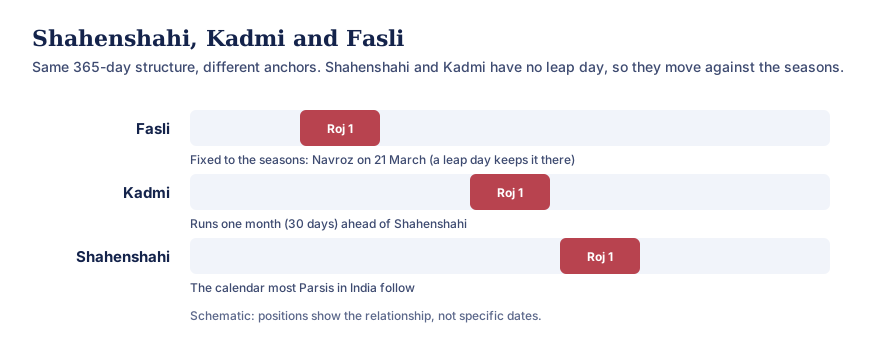
All three calendars have 12 months of 30 days plus 5 Gatha days. The Fasli calendar adds a leap day so Navroz stays on 21 March. The Shahenshahi and Kadmi calendars do not add a leap day, so they slowly move against the seasons; the Kadmi calendar runs one month (30 days) ahead of the Shahenshahi calendar.
Shahenshahi
The Shahenshahi calendar (also spelled Shenshai) is followed by most Parsis in India. It has no leap day, so each year is 365 days, about a quarter of a day shorter than the solar year. As a result, its new year moves earlier through the seasons by about one day every four years. Navroz in the Shahenshahi calendar currently falls in August.
Historically, an extra month was inserted from time to time to bring the calendar back into line with the seasons. Parsi tradition holds that one such month was added in India after the community’s arrival that was not added in Iran, which is how the Shahenshahi and Kadmi calendars came to differ.
Kadmi
The Kadmi calendar (also spelled Qadimi, meaning “ancient”) runs one month (30 days) ahead of the Shahenshahi calendar. In the 18th century, some members of the community concluded, after contact with Zoroastrians in Iran, that the Iranian reckoning was correct, and adopted it. Kadmi Navroz therefore falls a month before Shahenshahi Navroz. Like Shahenshahi, Kadmi has no leap day.
Fasli
The Fasli calendar (fasl means season), also called Bastani, adds a leap day every four years, so the calendar stays fixed to the seasons. Its Navroz is always on the spring equinox date of 21 March. It was promoted in the early 20th century and is followed by a part of the community, including many Irani Zoroastrians.
Separately, many Parsis whatever their calendar also celebrate Jamshedi Navroz on 21 March, linked to the legendary King Jamshed and the spring equinox.
Which should I choose?
Choose the calendar your family, agiary or fire temple follows. Most Parsi families in India follow Shahenshahi; if you’re unsure, ask the elders in your family or your agiary’s priest. You can change the calendar in OIOA at any time, for example to check when a relative following another calendar observes a day.
What changes when you switch
When you switch between calendars in OIOA:
- Today’s Roj and Mah change to that calendar’s reckoning.
- The Gahambars move to that calendar’s dates, and so do Navroz and the other days fixed by Roj and Mah.
- Everything else on your Home screen stays the same.
Calculated on your phone
The Parsi calendars are arithmetic: count days from a known epoch, divide into 30-day months and Gatha days, and, for Fasli, add leap days. OIOA does this on your device, so it works offline.
Learn more
- Shahenshahi, Kadmi and Fasli, a fuller history.
- Parsi Roj and Mah
- The Parsi calendars
If a Roj, Mah or date doesn’t match your agiary’s calendar, please tell us what we missed.