Festivals of the seasons
The Gahambars (also Gahanbars) are among the oldest Zoroastrian observances. There are six, spread through the year, each lasting five days. They celebrate the seasons and, in tradition, the six stages of creation: the sky, water, earth, plants, animals and humankind.
The Gahambars are deeply communal. Families and community trusts sponsor a jashan (thanksgiving ceremony) and a shared meal, and everyone is welcome. The idea of giving, gathering and sharing food together is at the heart of the festival.
Text version of this diagram
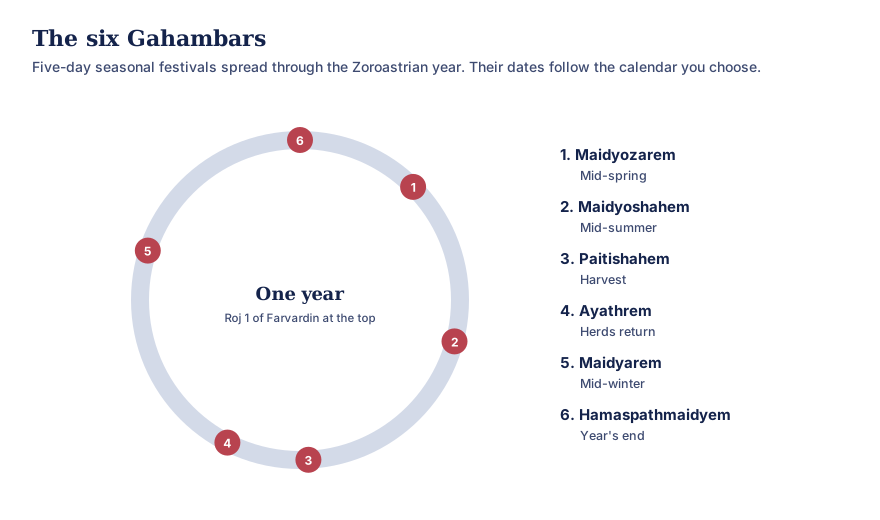
The six Gahambars, each five days long, in order through the year: Maidyozarem (mid-spring), Maidyoshahem (mid-summer), Paitishahem (harvest), Ayathrem (herds return), Maidyarem (mid-winter) and Hamaspathmaidyem (the last days of the year, the Gatha days).
The six Gahambars
| Gahambar | Season in tradition | Where in the year (Roj of Mah) | |
|---|---|---|---|
| 1 | Maidyozarem | Mid-spring | Roj 11–15 of Ardibehesht |
| 2 | Maidyoshahem | Mid-summer | Roj 11–15 of Tir |
| 3 | Paitishahem | Harvest of grain | Roj 26–30 of Shehrevar |
| 4 | Ayathrem | Return of the herds | Roj 26–30 of Meher |
| 5 | Maidyarem | Mid-winter | Roj 16–20 of Dae |
| 6 | Hamaspathmaidyem | Year’s end | The five Gatha days |
The last Gahambar, Hamaspathmaidyem, coincides with the Gatha days at the end of the year, during the period of the Muktad when the souls of the departed are remembered.
Why the Gregorian dates differ
The Gahambars are fixed by Roj and Mah, not by Gregorian date. So:
- In the Fasli calendar, which keeps Navroz on 21 March, each Gahambar falls on the same Gregorian dates every year and stays in its intended season.
- In the Shahenshahi and Kadmi calendars, which have no leap day, the Gahambars move gradually through the Gregorian year, and Kadmi’s are a month ahead of Shahenshahi’s.
When you choose your calendar on the Parsi Home screen, OIOA shows the Gahambars on the dates that calendar gives. See calendar methods.
Taking part
Customs vary between families, agiaries and community trusts, but a Gahambar commonly includes:
- a jashan ceremony performed by mobeds,
- prayers, including the Afrinagan,
- a community meal, sponsored as an act of charity and open to all,
- remembering and including those who cannot attend.
Many people try to attend or sponsor at least one Gahambar a year. If you’d like a nudge, set a reminder for the first day of each.
Calculated on your phone
The Gahambars follow directly from the Roj and Mah, which OIOA calculates on your device for the calendar you’ve chosen. They work offline.
Learn more
If your agiary observes a Gahambar on a different day, or a name is spelled differently in your tradition, please tell us what we missed.