What GST is
The Goods and Services Tax (GST) is India’s main indirect tax on the supply of goods and services. It replaced a range of central and state taxes from 1 July 2017. Businesses collect GST from customers and pay it to the government, claiming credit for the GST they themselves paid on inputs.
For everyday purposes, what matters is the arithmetic: how much tax is in a price, and what the total comes to.
Formula 1: adding GST (exclusive price)
When you know the price before tax (the taxable value):
- GST = price × rate
- Total = price × (1 + rate)
Example: a service priced at ₹2,500 with GST at 18%.
- GST = 2,500 × 0.18 = ₹450
- Total = 2,500 + 450 = ₹2,950
Formula 2: extracting GST (inclusive price)
When you know the total, which already includes GST:
- Price before tax = total ÷ (1 + rate)
- GST = total − price before tax, or equivalently total × rate ÷ (1 + rate)
Example: an item sold for ₹590 including 18% GST.
- Price before tax = 590 ÷ 1.18 = ₹500
- GST = 590 − 500 = ₹90
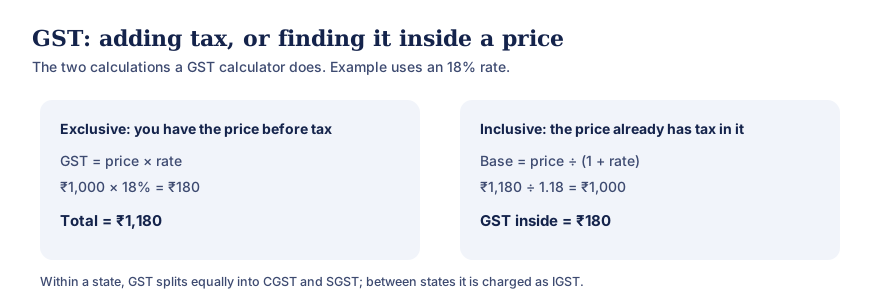
Text version of this diagram
Exclusive (price before tax): GST = price × rate. ₹1,000 × 18% = ₹180, total ₹1,180.
Inclusive (price already includes tax): base = price ÷ (1 + rate). ₹1,180 ÷ 1.18 = ₹1,000, so the GST inside is ₹180.
Within a state, GST is split equally into CGST and SGST; between states it is charged as IGST.
The most common mistake
People often take the rate as a percentage of the total to find the tax inside it: 18% of ₹590 = ₹106.20. That’s wrong. The 18% was charged on ₹500, not ₹590. The correct tax is ₹90.
A handy shortcut: for 18%, the GST inside an inclusive price is total × 18/118, roughly 15.25% of the total. For 5%, it’s total × 5/105, about 4.76%. For 40%, total × 40/140, about 28.57%.
CGST, SGST, UTGST and IGST
GST is a single tax, but it’s shared between the Centre and the states, and invoices show how:
- Intra-state supply (seller and place of supply in the same state): the GST is split equally into CGST (Central) and SGST (State). At 18%: 9% CGST + 9% SGST. In union territories without their own legislature, UTGST replaces SGST.
- Inter-state supply (different states, or imports): the full rate is charged as IGST (Integrated). At 18%: 18% IGST.
The total tax is the same; only the split differs.
Example: ₹10,000 taxable value at 18% within Maharashtra: CGST ₹900 + SGST ₹900 = ₹1,800, total ₹11,800. The same supply from Maharashtra to Gujarat: IGST ₹1,800, total ₹11,800.
The current slab structure
GST rates were rationalised with effect from 22 September 2025. Most goods and services now fall in two main slabs, 5% and 18%, with a 40% rate for a narrow set of luxury and “sin” goods. Some essentials and services are exempt (nil-rated), and a few items carry special rates. The earlier 12% and 28% slabs were folded into this structure.
The rate for a particular item depends on its classification (HSN code for goods, SAC code for services), and rates can change after GST Council meetings. Always confirm the current rate for a specific item on the official GST portal or with a tax professional.
Rounding
- Calculate tax to the paisa, then round as your invoicing practice requires.
- Invoice totals are commonly rounded to the nearest rupee, with a “round off” line.
- When splitting into CGST and SGST, compute each half, so ₹90.01 of GST might appear as ₹45.01 + ₹45.00 depending on your software’s rule. Small differences of a paisa are normal.
Quick reference
| You know | You want | Formula |
|---|---|---|
| Taxable value | GST | value × rate |
| Taxable value | Total | value × (1 + rate) |
| Total (inclusive) | Taxable value | total ÷ (1 + rate) |
| Total (inclusive) | GST | total × rate ÷ (1 + rate) |
| GST, intra-state | CGST, SGST | each = GST ÷ 2 |
In OIOA
OIOA includes a GST calculator on every community’s Home screen. It runs on your phone and works offline. Results are indicative: tax rules are detailed and change from time to time, so check against official sources before filing returns or issuing invoices, as the disclaimer explains.
Common questions
What is 18% GST on ₹1,000?
₹180, making a total of ₹1,180. Within a state, that’s ₹90 CGST and ₹90 SGST.
How do I calculate GST backwards from a total?
Divide the total by (1 + rate) to get the price before tax, then subtract. For 5% GST on a total of ₹2,100: 2,100 ÷ 1.05 = ₹2,000, so the GST is ₹100.
Is GST charged on top of the MRP?
No. In India, the MRP (maximum retail price) printed on packaged goods is inclusive of all taxes, including GST. A retailer may not charge more than the MRP. To find the GST inside it, use the inclusive formula.
Does a small business have to charge GST?
Registration and charging GST depend on turnover thresholds, the kind of goods or services, whether you sell between states, and other conditions. The rules are detailed; please check the official GST portal or ask a tax professional for your situation.
What is input tax credit?
A registered business can usually reduce the GST it pays to the government by the GST it has itself paid on purchases used in its business. That’s how GST avoids taxing the same value twice along the supply chain. The conditions for claiming credit are set out in the GST rules.
Why do restaurant bills show different GST rates?
Restaurant services have their own rates depending on the type of establishment, and rates have changed over time. Check the current notification if you need to know the rate for a particular case.
Key terms
- Taxable value: the price before GST.
- CGST / SGST / UTGST: the central and state (or union territory) shares of GST on supplies within a state or UT.
- IGST: GST on supplies between states, and on imports.
- HSN / SAC: classification codes for goods and services, which decide the rate.
- Input tax credit: GST paid on business inputs that can be set against GST collected.
A final tip
Keep the two formulas, multiply to add GST and divide to remove it, and you’ll answer almost every everyday GST question correctly in seconds.