Many lists, not one
“Is it a holiday?” sounds like a simple question, but in India the answer depends on who you are and where you work. Several overlapping lists exist:
National holidays. Three days are observed across the whole country: Republic Day (26 January), Independence Day (15 August) and Gandhi Jayanti (2 October).
Central government holidays. Each year the central government publishes, for its offices, a list of compulsory (gazetted) holidays, which include the national holidays and festivals of several communities, and a list of restricted (optional) holidays from which employees may choose a limited number.
State holidays. Each state and union territory notifies its own list, reflecting regional festivals and commemorations. A harvest festival or a regional new year may be a holiday in one state and a working day next door.
Bank holidays. Bank closures are notified separately, state by state, and published by the Reserve Bank of India. Second and fourth Saturdays are also bank holidays.
Your employer’s list. Private companies, schools and colleges usually publish their own list, which may follow the state or central list, or neither exactly.
What a long weekend is
A long weekend happens when a holiday sits next to the weekend, so you get three or more consecutive days off without taking leave. A bridge day is a single working day between a holiday and the weekend that, if taken as leave, joins them into a longer break.
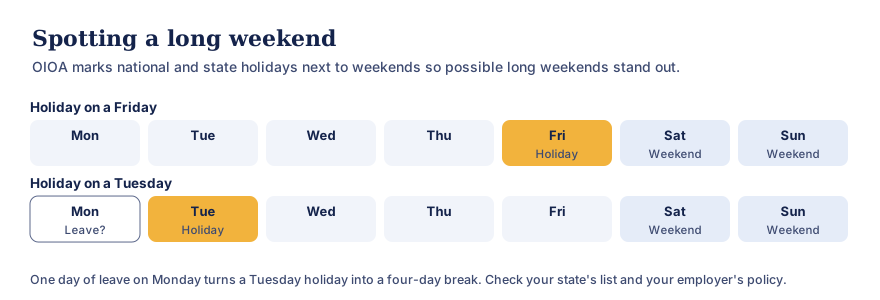
Text version of this diagram
Example 1: a holiday on Friday plus Saturday and Sunday gives a three-day weekend.
Example 2: a holiday on Tuesday; taking Monday as leave joins it to the weekend for a four-day break.
| Holiday falls on | Without leave | With one day of leave |
|---|---|---|
| Monday | 3 days (Sat–Mon) | n/a |
| Tuesday | 1 day | 4 days, with Monday off |
| Wednesday | 1 day | 3 or 5 days, with two days off |
| Thursday | 1 day | 4 days, with Friday off |
| Friday | 3 days (Fri–Sun) | n/a |
(Assuming a Saturday–Sunday weekend; for six-day weeks, adjust accordingly.)
Why some festival holidays move
Many festivals follow a lunar or lunisolar calendar, so they fall on different Gregorian dates each year:
- Hindu and Jain festivals follow the panchang and shift by a few weeks from year to year.
- Islamic festivals move about 11 days earlier each year, and their exact day may depend on moon sighting; government lists often note that the date may change.
- Some Sikh gurpurabs, under the SGPC method, follow lunar dates.
- Parsi Navroz in the Shahenshahi or Kadmi calendar moves slowly.
So each year’s long weekends are different, and occasionally a holiday is moved after a list is published. That’s why it’s worth checking the latest official notification before you book anything non-refundable.
A practical planning routine
- At the start of the year, look through the national and state holidays and note the possible long weekends.
- Check your employer’s list to confirm which of those days you actually get off.
- Identify bridge days worth taking as leave, and apply early: popular ones go quickly.
- Book travel early for festival long weekends, when trains, flights and hotels fill up.
- Set reminders for when to apply for leave and when booking opens.
- Recheck a few weeks before, in case a holiday has been moved.
Long weekends and togetherness
India’s holiday list reflects its diversity: Holi and Eid, Christmas and Guru Nanak Jayanti, Mahavir Jayanti and Navroz, Pongal, Onam and Bihu. Long weekends are a chance to travel, but also to spend a festival with neighbours and friends from other communities. A festival you don’t celebrate yourself is still a chance to wish someone who does.
In OIOA
OIOA’s holidays and long weekends feature shows national and state holidays together and marks possible long weekends, the same for every community. Plan a trip in a group, and set reminders for leave applications and bookings. Holiday data can be provisional, so please confirm with official notifications, as the disclaimer explains.
Common questions
What is a restricted holiday?
Central government employees get a list of restricted (optional) holidays from which they can choose a limited number each year, in addition to the compulsory holidays. The list covers festivals and observances of many communities, so people can take the days that matter to them.
What is a gazetted holiday?
A holiday notified in the official gazette for government offices. In common speech it usually means the compulsory holidays on the central or state list.
Are second and fourth Saturdays holidays?
For banks, yes. For many government offices, a five-day week already makes every Saturday a holiday. For private employers and schools, it depends on their own policy.
Do all states have the same holidays?
No. Apart from the three national holidays, states choose their own lists, and regional festivals vary widely. That’s why OIOA shows state holidays alongside national ones.
When are holiday lists published?
Central and state governments usually publish the next year’s lists towards the end of the current year. Revisions can follow during the year, especially for festivals that depend on the lunar calendar or moon sighting.
How far ahead should I book for a festival long weekend?
For popular routes and destinations, as early as you can. Train reservations in India open a set number of days in advance, and festival dates fill quickly. A reminder for the day bookings open helps.
Key terms
- Gazetted holiday: a holiday notified in the official gazette for government offices.
- Restricted holiday: an optional holiday chosen from a published list.
- Bridge day: a working day between a holiday and a weekend, often taken as leave.
- Bank holiday: a day when banks are closed, notified separately by state.
Does OIOA show restricted holidays?
OIOA shows national and state holidays. For the central government’s restricted holiday list, check the official notification for the year.
The best long weekend is often the one shared with neighbours of another community.