OIOA promises to be open to any community that asks, and to welcome correction. Promises like that are only worth something if there’s a process behind them. Here’s ours.
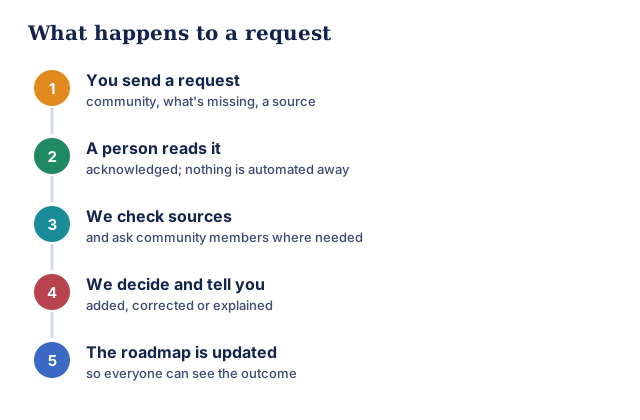
Text version of this diagram
- You send a request: the community, what is missing, and a source if you have one.
- A person on the OIOA team reads it.
- We check sources, and ask community members where needed.
- We decide and tell you: added, corrected, or explained.
- The public roadmap is updated so everyone can see the outcome.
1. A person reads it
Every request and every correction is read by a person on the OIOA team. Nothing is filtered out automatically, except obvious spam. If you left contact details and agreed to a reply, we note that.
2. We sort it
Requests usually fall into one of these kinds:
- A new community or tradition, such as a community not yet in OIOA, or a sect within one that is.
- A calendar method, such as a different way of calculating a date that a community follows.
- A correction: a date, a timing, a name or a translation that’s wrong.
- A language: a new language, or a better word in an existing one.
- Something else, including concerns about how a community is represented.
3. We check sources
For calendars, accuracy comes from sources. We look at what you’ve shared, such as a published jantri, a mosque’s timetable, an agiary’s calendar or a sangh’s tippanu, and we look for others. Where it helps, we ask members of the community, and where there are genuinely different practices, we try to understand all of them rather than choosing one.
Many reported differences turn out to be explained by location (a calendar made for another city) or a method setting (for example, a different prayer-time method). When that’s the case, we explain it. When it’s our mistake, we fix it.
4. We decide, and tell you
The outcome is one of:
- Added or corrected, and noted on the roadmap once it’s in the app.
- Explained, when there’s a reason for the difference and nothing needs changing.
- Under review, when something needs more work or more sources, listed on the roadmap as requested, under review.
- Not possible right now, with the reason.
If you left contact details, we aim to reply within 15 days, even if the reply is “we’re still working on it”.
5. We keep a public record
The roadmap shows what’s live, what we’ve committed to, and what’s under review. Our Community Content & Correction Policy sets out these commitments formally.
What we won’t do
- We won’t decide that one tradition is “correct” and another isn’t.
- We won’t ignore a request because a community is small.
- We won’t publish a community’s calendar until we’re confident it’s right.
Send yours
Request a community, sect, calendar or language, or tell us what we missed.